
Introduction
App reviews play a very important role in today’s digital world. Whenever someone downloads a new mobile application, the first thing they usually check is app reviews. These reviews help users understand whether an app is useful, safe, and worth their time. For beginners and intermediate users, app reviews act like guidance from real people who have already used the app.
In simple words, app reviews are opinions shared by users after using an application. These opinions can be positive, negative, or mixed, depending on the user experience. Because of this, app reviews influence download decisions, app rankings, and even the success or failure of an application.
Today, millions of apps are available on different platforms. This makes choosing the right app difficult. That is where app reviews become helpful. They save time, reduce risk, and provide real insights that marketing descriptions often hide. Developers also rely on app reviews to improve their apps and fix problems.
In this detailed guide, you will learn everything about app reviews. We will explain what app reviews are, why they are important, how to write them step by step, their benefits and risks, common mistakes, FAQs, and expert tips. This article is written in simple English, uses short paragraphs, and is suitable for beginners as well as intermediate readers.
What is App Reviews?
App reviews are written feedback or ratings shared by users after using a mobile or web application. These reviews usually appear on app stores or platforms where apps are downloaded.
App reviews include user opinions about app features, performance, design, usability, and overall experience. Most app reviews also include star ratings, usually from one to five stars.
There are two main types of app reviews. The first type is user-generated app reviews. These come from real users who have downloaded and used the app. The second type is expert app reviews. These are written by professionals who test apps in detail and provide structured feedback.
App reviews help other users make informed decisions. At the same time, developers use app reviews to understand user needs, detect bugs, and improve future updates.
In short, app reviews act as a bridge between users and developers, creating trust and transparency in the app ecosystem.
Why is App Reviews Important?
App reviews are important for many reasons. They affect users, developers, and even app stores.
For users, app reviews reduce confusion. With so many apps available, reviews help users quickly decide which app suits their needs. Reading app reviews can prevent downloading poor-quality or unsafe apps.
For developers, app reviews are a direct source of feedback. Positive app reviews increase app visibility and trust. Negative app reviews highlight problems that need fixing. This feedback helps developers improve app quality over time.
App stores also rely on app reviews. Apps with better reviews usually rank higher in search results. This increases downloads and engagement.
Moreover, app reviews build credibility. When users see honest and detailed app reviews, they feel more confident. That confidence often turns into downloads and long-term usage.
Therefore, app reviews are not just opinions. They are powerful tools that shape the success of applications.
Detailed Step-by-Step Guide
Step 1: Use the App Properly
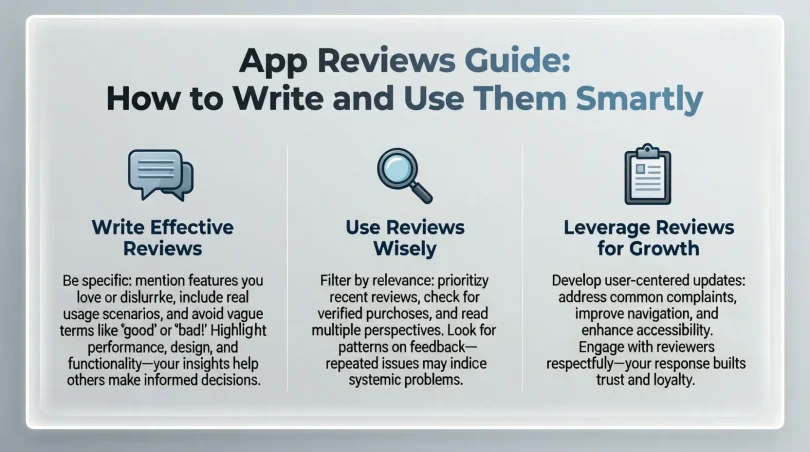
Before writing app reviews, use the app for some time. Explore its features, test its performance, and understand its purpose. A good app review is based on real experience, not assumptions.
Step 2: Identify the App’s Purpose
Every app is created to solve a problem. In your app review, mention whether the app successfully fulfills its purpose. This helps readers understand if the app matches their needs.
Step 3: Evaluate Key Features
Focus on important features. Mention what works well and what does not. Balanced app reviews are more helpful and trustworthy.
Step 4: Check Usability and Design
Good app reviews always discuss ease of use. Is the app easy to navigate? Is the design user-friendly? These points matter to most users.
Step 5: Discuss Performance
Performance is a major factor in app reviews. Mention app speed, crashes, bugs, or loading issues. Honest feedback helps both users and developers.
Step 6: Rate Fairly
Use star ratings carefully. Match your rating with your written feedback. Fair ratings make app reviews reliable.
Step 7: Write Clearly and Simply
Use simple language. Avoid long sentences. Clear app reviews are easier to read and more useful.
Step 8: Update Reviews When Needed
If the app improves or changes, update your app review. Updated app reviews stay relevant and accurate.
Benefits of App Reviews

- Help users make better app choices
- Save time by reducing trial and error
- Increase trust and transparency
- Improve app quality through feedback
- Help developers understand user needs
- Improve app store rankings
- Encourage healthy competition
- Support continuous app improvement
Disadvantages / Risks
- Fake or paid app reviews can mislead users
- Extremely negative reviews may discourage fair use
- Emotional reviews may lack objectivity
- Outdated app reviews may no longer be accurate
- Review bombing can damage app reputation unfairly
Common Mistakes to Avoid
Many people make mistakes while writing or using app reviews. One common mistake is writing reviews without properly using the app. This reduces credibility.
Another mistake is focusing only on emotions. Angry or overly excited app reviews often miss important details. Balanced reviews are always better.
Some users write very short app reviews that provide no value. Simple words are fine, but details are necessary.
Ignoring updates is another mistake. Apps change frequently, so old app reviews may become irrelevant.
Lastly, blindly trusting all app reviews is risky. Always read multiple reviews to form a clear opinion.
FAQs
What are app reviews used for?
App reviews are used to share user experiences, help others choose apps, and provide feedback to developers. They guide decision-making and improve app quality.
Are app reviews always reliable?
Not all app reviews are reliable. Some may be fake or biased. Reading multiple app reviews helps identify genuine opinions.
How many app reviews should I read before downloading?
There is no fixed number. However, reading a mix of recent positive and negative app reviews gives a balanced view.
Can developers respond to app reviews?
Yes, many platforms allow developers to reply to app reviews. This helps resolve issues and shows professionalism.
Do app reviews affect app rankings?
Yes, app reviews influence rankings. Apps with higher ratings and positive app reviews usually appear higher in search results.
Should I update my app review after updates?
Yes, updating app reviews after improvements or changes keeps feedback accurate and helpful.
Expert Tips & Bonus Points
Always look for detailed app reviews instead of short comments. Details reveal real experiences.
Check recent app reviews first. They reflect the current version of the app.
Pay attention to repeated issues mentioned in app reviews. Repetition often indicates real problems.
When writing app reviews, be honest but respectful. Constructive feedback helps everyone.
Use app reviews as guidance, not final judgment. Personal needs may differ.
If you are a developer, analyze app reviews regularly. They are free insights for improvement.
Conclusion
App reviews are a powerful part of the digital app ecosystem. They help users make smart choices and guide developers toward improvement. Without app reviews, choosing the right app would be much harder and riskier.
For users, app reviews save time and reduce frustration. They provide real experiences that marketing descriptions often miss. For developers, app reviews act as direct communication with users. They highlight strengths, weaknesses, and areas for growth.
However, app reviews should always be used wisely. Not every review is genuine, and not every negative comment reflects the full picture. Reading multiple app reviews and focusing on recent feedback is the best approach.
Whether you are reading or writing app reviews, honesty and balance are key. When used correctly, app reviews create trust, improve quality, and make the app world better for everyone.