
Introduction
In today’s fast-moving digital world, managing time and tasks has become more challenging than ever. Students, professionals, freelancers, and business owners all struggle with distractions, heavy workloads, and tight deadlines. This is where productivity tools play a powerful role. Productivity tools help people plan their work, organize tasks, reduce stress, and focus on what truly matters. Instead of working longer hours, these tools help you work smarter and achieve better results in less time software reviews.
Productivity tools are no longer only for large companies or tech experts. They are now simple, affordable, and easy to use for beginners as well as intermediate users. Whether you want to manage your daily to-do list, track time, collaborate with a team, or reduce digital clutter, there is a productivity tool designed for that purpose. When used correctly, productivity tools can improve efficiency, boost motivation, and create a healthy work-life balance.
Another reason productivity tools are becoming popular is remote work and online learning. People now work from different locations and need smart systems to stay connected and organized. Productivity tools provide structure, reminders, and automation that save mental energy. Instead of remembering everything, users can rely on systems that support consistent progress.
This complete guide will help you understand productivity tools in a clear and practical way. You will learn what they are, why they matter, how to use them step by step, and how to avoid common mistakes. By the end, you will know how to choose and use productivity tools confidently in your daily life.
What is Productivity Tools?
Productivity tools are digital or physical resources that help individuals and teams complete tasks more efficiently. These tools are designed to save time, improve focus, and organize work in a structured way. Productivity tools can be simple, like a task list, or advanced, like project management software.
Most modern productivity tools are software-based and work on computers, tablets, or smartphones. They help users manage tasks, set goals, schedule time, track progress, and collaborate with others. Some tools focus on personal productivity, while others are built for teams and businesses.
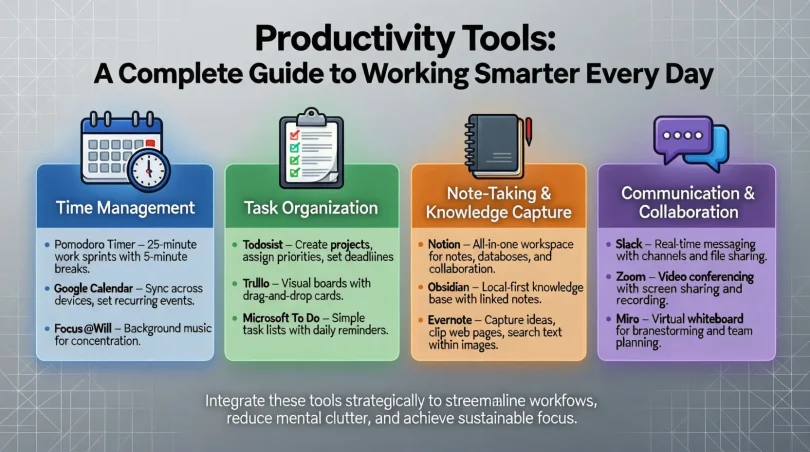
Productivity tools are not limited to one category. They include task managers, calendar apps, note-taking tools, time trackers, communication platforms, and automation tools. Each type serves a specific purpose, but all share the same goal of improving efficiency.
The true value of productivity tools lies in how they reduce mental load. Instead of keeping everything in your head, you store tasks, deadlines, and ideas in a reliable system. This allows your mind to focus on creative and important work rather than constant reminders.
Why is Productivity Tools Important?
Productivity tools are important because they help people manage their limited time and energy more effectively. In a world full of distractions, staying focused is difficult. Productivity tools create structure and clarity, which leads to better performance.
One key benefit is improved time management. Productivity tools help users see where their time goes and plan their day more realistically. This reduces last-minute stress and missed deadlines. When tasks are clearly organized, it becomes easier to prioritize important work.
Another reason productivity tools matter is consistency. Motivation can change from day to day, but systems remain reliable. Productivity tools support steady progress even on low-energy days. They help build habits and routines that lead to long-term success.
Productivity tools also improve collaboration. Teams can share tasks, communicate clearly, and track progress in one place. This reduces confusion and improves accountability. As a result, work becomes smoother and more transparent.
Finally, productivity tools support work-life balance. By organizing tasks efficiently, users can finish work on time and enjoy personal life without constant worry.
Detailed Step-by-Step Guide
Step 1: Identify Your Productivity Needs
Before choosing productivity tools, understand your needs. Think about where you struggle the most. Is it time management, task organization, focus, or teamwork? Write down your daily challenges.
Some people need simple task lists, while others need advanced project tracking. Choosing tools without understanding your needs often leads to confusion and wasted time.
Step 2: Choose the Right Type of Productivity Tools
Once you know your needs, select the right category of productivity tools. Common types include task management, time tracking, note-taking, and communication tools.
For beginners, starting with one or two basic productivity tools is enough. Avoid using too many tools at once, as this can reduce effectiveness.
Step 3: Set Clear Goals and Tasks
Productivity tools work best when tasks are clear and specific. Break large goals into small, actionable steps. This makes tasks easier to manage and less overwhelming.
Use clear titles and short descriptions. Set deadlines that are realistic and flexible. Clear tasks lead to better focus and faster completion.
Step 4: Create a Daily and Weekly System
Consistency is key when using productivity tools. Create a daily routine to check tasks and plan work. Weekly reviews help you adjust priorities and track progress.
A simple system might include planning tasks in the morning and reviewing progress at the end of the day. This habit improves awareness and control.
Step 5: Use Reminders and Notifications Wisely
Reminders are helpful, but too many notifications can become distracting. Set reminders only for important tasks and deadlines.
Use notifications as support, not pressure. The goal is to stay informed without feeling overwhelmed.
Step 6: Track Progress and Adjust
Productivity tools allow you to track completed tasks and time spent. Use this data to understand your work patterns. Identify what works and what does not.
Regular adjustments help you improve your system. Productivity tools should adapt to your life, not control it.
Benefits of Productivity Tools

- Improve time management and planning
- Reduce stress and mental overload
- Increase focus and concentration
- Support consistent work habits
- Improve task organization
- Enhance team collaboration
- Save time through automation
- Help achieve goals faster
- Create better work-life balance
Disadvantages / Risks
- Too many tools can cause confusion
- Overplanning can reduce flexibility
- Notifications may become distracting
- Learning new tools takes time
- Dependence on tools may reduce creativity
- Poor setup can waste effort
Common Mistakes to Avoid
Many people make mistakes when using productivity tools, which reduces their effectiveness. One common mistake is using too many tools at once. This creates complexity instead of simplicity.
Another mistake is setting unrealistic goals. Productivity tools cannot fix poor planning. Overloading your schedule leads to frustration and burnout.
Ignoring regular reviews is also a problem. Productivity tools require maintenance. Without reviews, tasks pile up and systems become outdated.
Some users focus too much on organizing instead of doing. Productivity tools should support action, not replace it. Balance planning with execution.
FAQs
What are productivity tools used for?
Productivity tools are used to organize tasks, manage time, and improve efficiency. They help individuals and teams work smarter and reduce stress.
Are productivity tools suitable for beginners?
Yes, productivity tools are suitable for beginners. Many tools are simple and user-friendly, making them easy to learn and use.
How many productivity tools should I use?
It is best to start with one or two productivity tools. Adding more tools should only happen when there is a clear need.
Can productivity tools improve focus?
Yes, productivity tools can improve focus by reducing distractions and providing clear task lists and priorities.
Do productivity tools work for students?
Productivity tools work very well for students. They help manage study schedules, assignments, and exam preparation.
Are productivity tools expensive?
Many productivity tools are free or affordable. Paid versions usually offer advanced features but are not always necessary.
Expert Tips & Bonus Points
Start small and build gradually. Master one productivity tool before adding another. Keep your system simple and flexible.
Review your tasks regularly and remove anything unnecessary. Clarity improves focus and motivation.
Use productivity tools to support your natural work style. Do not copy others blindly. Customize tools to match your habits.
Remember that productivity tools are helpers, not solutions. Real productivity comes from consistent action and healthy routines.
Conclusion
Productivity tools are powerful allies in today’s busy world. They help people manage tasks, time, and energy more effectively. When used correctly, productivity tools reduce stress and improve focus. They provide structure without limiting creativity and freedom.
For beginners and intermediate users, productivity tools offer a clear path to better organization and performance. The key is choosing the right tools, setting clear goals, and building simple habits. Avoid common mistakes and focus on progress rather than perfection.
Productivity tools are not about doing more work. They are about doing the right work in a smarter way. With patience and practice, anyone can use productivity tools to create a balanced, productive, and fulfilling daily routine.