
Introduction
Automation solutions have become a cornerstone of modern business operations. In today’s fast-paced world, companies are constantly looking for ways to reduce manual effort, minimize errors, and enhance productivity. From small startups to large enterprises, automation is no longer optional—it’s a necessity. By integrating automation solutions, businesses can streamline repetitive tasks, improve accuracy, and free up employees for more strategic work.
Automation solutions are not limited to any single industry. They are widely used in manufacturing, IT, customer service, marketing, finance, and even healthcare. For example, in manufacturing, robotic process automation can handle repetitive assembly tasks, while in finance, software can automate invoice processing or account reconciliation. These solutions help companies save time, reduce operational costs, and maintain consistent quality.
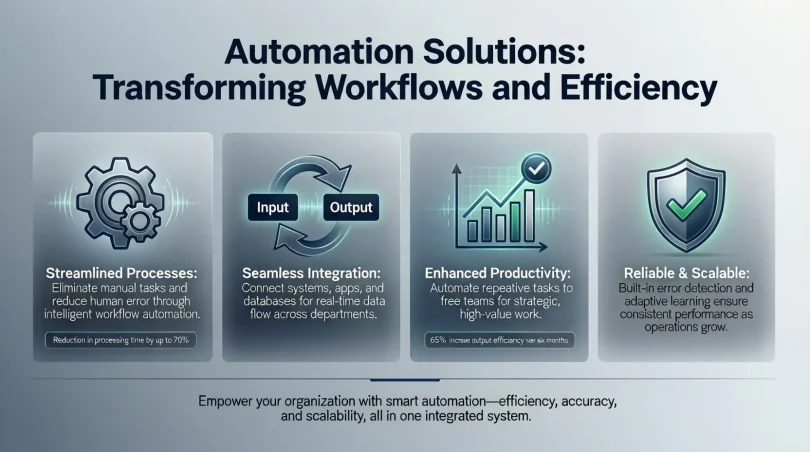
One of the most attractive aspects of automation solutions is their scalability. As a business grows, the same automated systems can handle increased workload without requiring proportional increases in human resources. Additionally, automation tools often come with analytics and reporting features, helping managers make informed decisions quickly. In short, automation solutions empower businesses to operate smarter, faster, and more efficiently.
By the end of this article, you’ll gain a complete understanding of automation solutions, their benefits, potential risks, and how to implement them effectively. Whether you are a beginner exploring automation for the first time or an intermediate user aiming to improve processes, this guide will equip you with practical knowledge to transform your workflows.
What is Automation Solutions?
Automation solutions refer to the use of technology to perform tasks that would otherwise require human intervention. These tasks can range from simple, repetitive processes to complex workflows across multiple systems. Automation solutions use software, machines, or AI-driven tools to handle tasks with minimal human involvement.
Common examples include:
- Robotic Process Automation (RPA): Software bots performing routine business tasks such as data entry or report generation.
- Industrial Automation: Machines and robots controlling production lines in manufacturing.
- IT Process Automation: Tools that manage system monitoring, server updates, or network configurations.
- Marketing Automation: Software that schedules posts, sends emails, or tracks customer interactions.
The primary goal of automation solutions is to increase efficiency, reduce errors, and save time. Unlike traditional tools that simply assist humans, automation solutions can independently carry out complete processes, providing measurable improvements in productivity.
Why is Automation Solutions Important?
Automation solutions are crucial in today’s business environment for several reasons:
- Time Efficiency: Automation handles repetitive tasks quickly, allowing employees to focus on strategic work.
- Cost Reduction: Fewer manual errors and faster processes lead to lower operational costs.
- Consistency and Accuracy: Automated systems perform tasks consistently, eliminating human errors.
- Scalability: Businesses can handle larger volumes of work without proportionally increasing staff.
- Data Insights: Many automation tools collect and analyze data, providing valuable business insights.
- Competitive Advantage: Early adoption of automation can give companies an edge over competitors by increasing speed and productivity.
For instance, customer support teams can use chatbots to handle simple queries instantly, reducing response time and improving customer satisfaction. Similarly, in finance, automation solutions can instantly reconcile accounts that would take hours manually.
Detailed Step-by-Step Guide to Implementing Automation Solutions

Implementing automation solutions requires careful planning and execution. Below is a detailed guide to help businesses integrate automation effectively:
Step 1: Identify Tasks Suitable for Automation
- List all repetitive or time-consuming processes.
- Focus on tasks prone to human error.
- Examples: data entry, invoice processing, report generation, email follow-ups.
Step 2: Set Clear Objectives
- Define what you want to achieve: faster processing, cost savings, improved accuracy.
- Establish measurable KPIs to track automation performance.
Step 3: Choose the Right Automation Tools
- Research software or machines suitable for your tasks.
- Consider factors like ease of use, scalability, integration with existing systems, and cost.
- Examples: RPA tools like UiPath or Automation Anywhere for business processes.
Step 4: Map and Document Processes
- Create detailed process maps to understand every step of the workflow.
- Identify inputs, outputs, and decision points for automation.
Step 5: Develop and Test Automation
- Implement automation in a controlled environment.
- Test thoroughly to ensure it performs tasks accurately and efficiently.
- Make adjustments based on testing results.
Step 6: Train Employees
- Educate staff on how automation tools work.
- Emphasize collaboration between humans and automation, not replacement.
Step 7: Monitor and Optimize
- Track performance using KPIs.
- Optimize automated processes to handle changes in business operations.
- Regular updates prevent outdated automation from creating errors.
Step 8: Scale Gradually
- Start with one department or process.
- Expand automation gradually to other areas of the business.
Benefits of Automation Solutions
Automation solutions offer numerous benefits for businesses:
- Increased Productivity: Tasks are completed faster and more efficiently.
- Reduced Operational Costs: Fewer errors and lower manual labor costs.
- Improved Accuracy: Consistent results with minimal mistakes.
- Enhanced Customer Experience: Faster response times and reliable services.
- Better Data Management: Automated data collection and reporting.
- Scalability: Easily handle increased workload without additional staff.
- Employee Satisfaction: Reduces mundane work, allowing employees to focus on strategic tasks.
Disadvantages / Risks of Automation Solutions
While automation solutions provide significant benefits, they come with some risks:
- High Initial Investment: Costly setup, especially for advanced automation systems.
- Job Displacement Concerns: Employees may fear losing jobs to automation.
- Technical Issues: System failures or software bugs can disrupt operations.
- Security Risks: Automation may increase exposure to cyber threats if not managed properly.
- Over-reliance: Too much dependency on automation can reduce human oversight.
- Complex Maintenance: Requires regular updates and monitoring to remain effective.
Common Mistakes to Avoid
To maximize the benefits of automation solutions, avoid these common mistakes:
- Automating the Wrong Tasks: Not all processes benefit from automation. Focus on repetitive, high-volume tasks.
- Skipping Process Documentation: Without clear process mapping, automation may fail.
- Neglecting Employee Training: Staff should understand how to work with automated systems.
- Ignoring Security: Automation without proper cybersecurity measures can lead to breaches.
- Failing to Monitor: Automation should be regularly checked to ensure efficiency and accuracy.
- Trying to Automate Everything at Once: Start small and scale gradually.
FAQs
1. What is the main purpose of automation solutions?
Automation solutions aim to reduce manual effort, increase efficiency, and minimize errors in repetitive or complex tasks.
2. Can small businesses benefit from automation?
Yes, even small businesses can save time and costs by automating routine processes such as invoicing, social media posting, or customer follow-ups.
3. Do automation solutions replace employees?
Not necessarily. Automation handles repetitive tasks, allowing employees to focus on more strategic and creative work.
4. How much does automation implementation cost?
Costs vary depending on the complexity, tools used, and scale of automation. Initial investment can be high, but long-term savings often justify it.
5. Which industries benefit most from automation?
Industries like manufacturing, IT, finance, healthcare, marketing, and logistics see the highest benefits.
6. How do I choose the right automation tool?
Consider the tasks to automate, ease of integration, scalability, cost, and vendor support. Test tools before full deployment.
7. How can I ensure successful automation adoption?
Document processes clearly, train employees, start small, monitor performance, and optimize continuously.
8. Is automation safe for sensitive data?
Automation can be safe if proper cybersecurity measures, access controls, and encryption are in place.
Expert Tips & Bonus Points
- Start Small: Begin with simple, high-impact tasks before expanding.
- Measure ROI: Track metrics like time saved, error reduction, and cost savings.
- Integrate Across Systems: Ensure automation tools communicate with existing software for maximum efficiency.
- Regular Updates: Keep automation tools up-to-date to avoid technical failures.
- Employee Collaboration: Encourage employees to suggest automation opportunities—they know the processes best.
- Focus on Customer Experience: Automation should improve service speed and reliability.
Conclusion
Automation solutions are transforming the way businesses operate. By automating repetitive tasks, companies can reduce costs, improve accuracy, and boost overall productivity. These solutions are versatile, applicable across industries, and scalable for businesses of all sizes. While there are risks such as technical issues or high initial investment, careful planning and monitoring can mitigate these challenges.
Implementing automation solutions is not just about replacing manual work; it’s about empowering employees, improving workflows, and creating a competitive advantage. By understanding the steps, benefits, and potential pitfalls, businesses can harness the power of automation to operate smarter and achieve long-term success.
Whether you are just starting your automation journey or looking to optimize existing processes, embracing automation solutions is a step toward efficiency, innovation, and sustainable growth. The future belongs to businesses that leverage technology wisely, and automation is at the heart of that transformation.