
Introduction
Artificial Intelligence, commonly known as AI, has transformed the way we live, work, and interact with technology. AI systems are no longer a futuristic concept; they are now part of our everyday lives. From personalized recommendations on streaming platforms to virtual assistants on our phones, AI plays a vital role in improving efficiency and simplifying tasks. Understanding AI systems is essential for anyone looking to navigate today’s tech-driven world.
At its core, an AI system is designed to mimic human intelligence. These systems can analyze data, learn from patterns, and make decisions without constant human intervention. The growth of AI has been fueled by advancements in machine learning, neural networks, and big data. As businesses and individuals increasingly adopt AI solutions, knowing how these systems work and their potential benefits and risks becomes crucial.
This guide is designed to provide a comprehensive overview of AI systems. We will explore what AI systems are, why they are important, how they function, their benefits, disadvantages, and common mistakes to avoid. By the end of this guide, you will have a solid understanding of AI systems and practical insights on how to use them effectively.
What is AI Systems?
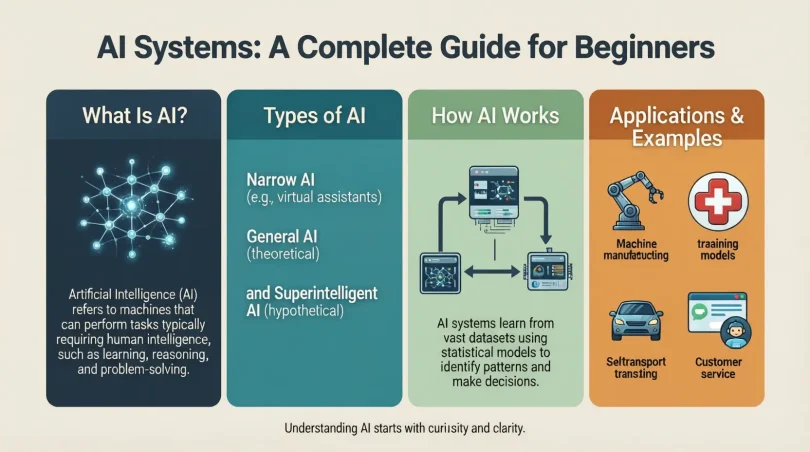
AI systems are computer programs designed to perform tasks that usually require human intelligence. These tasks include recognizing speech, understanding natural language, identifying patterns, and making decisions. Unlike traditional software, AI systems can improve over time by learning from data and experience.
AI systems are built on several key components:
- Data Input: The raw information the system uses to learn.
- Algorithms: Instructions that guide the system’s decision-making process.
- Machine Learning Models: Mathematical models that help the AI learn patterns and make predictions.
- Output: The results, which could be recommendations, predictions, or actions.
Examples of AI systems include voice assistants like Siri or Alexa, recommendation engines on Netflix, self-driving cars, and fraud detection systems used by banks. These systems continuously evolve, becoming more sophisticated and accurate over time.
Why is AI Systems Important?
AI systems are important for several reasons:
- Efficiency: AI can handle repetitive tasks faster than humans.
- Accuracy: AI systems can process large amounts of data with minimal errors.
- Decision-Making: AI supports informed decision-making by analyzing complex datasets.
- Personalization: AI systems enhance user experiences through personalized recommendations.
- Innovation: AI drives innovation across industries such as healthcare, finance, education, and transportation.
For example, in healthcare, AI systems can analyze medical images to detect diseases earlier than traditional methods. In business, AI can predict customer preferences, helping companies create targeted marketing strategies.
The importance of AI systems extends beyond convenience. They are reshaping industries, improving productivity, and offering solutions to complex global challenges.
Detailed Step-by-Step Guide to AI Systems
Understanding AI systems requires breaking down the process of how they work. Here is a detailed step-by-step guide:
Step 1: Data Collection
Data is the foundation of every AI system. Systems need large amounts of structured and unstructured data to learn effectively. Examples of data include text, images, videos, and sensor readings.
Step 2: Data Preprocessing
Raw data often contains errors, missing values, or irrelevant information. Preprocessing involves cleaning, normalizing, and transforming data to ensure accuracy and efficiency.
Step 3: Choosing the Right Algorithm
AI systems rely on algorithms to make decisions. Common algorithms include:
- Decision Trees for classification tasks
- Neural Networks for pattern recognition
- Regression Models for predicting numerical values
- Clustering Algorithms for grouping similar data points
Step 4: Training the AI System
Training involves feeding data into the system so it can learn patterns. This step is crucial for machine learning models, as the system improves its predictions over time.
Step 5: Testing and Validation
Before deployment, AI systems are tested on new data to measure accuracy and performance. Validation ensures the system performs well in real-world scenarios.
Step 6: Deployment
After successful testing, the AI system is deployed for actual use. It may run in software applications, websites, mobile apps, or specialized devices.
Step 7: Monitoring and Updating
AI systems require continuous monitoring to maintain performance. They may need updates as new data becomes available or as business needs change.
Benefits of AI Systems
AI systems offer numerous advantages:
- Automation: Reduces human workload by automating repetitive tasks.
- Enhanced Decision-Making: Uses data-driven insights to make better decisions.
- Cost Efficiency: Reduces operational costs by optimizing processes.
- Scalability: Can handle large-scale operations without proportional increases in resources.
- Personalization: Provides customized user experiences.
- Innovation Support: Drives new products, services, and business models.
For example, e-commerce platforms use AI to suggest products based on customer behavior, increasing engagement and sales.
Disadvantages / Risks of AI Systems
Despite their benefits, AI systems come with potential risks:
- Data Privacy Concerns: AI systems process sensitive information, which can be misused if not secured.
- Bias: AI can inherit biases present in the training data.
- Job Displacement: Automation may replace certain jobs, impacting employment.
- High Costs: Developing and maintaining AI systems can be expensive.
- Dependence on Data: Poor-quality data can lead to inaccurate results.
- Security Threats: AI systems may be vulnerable to hacking or misuse.
Understanding these risks is essential for safe and effective AI deployment.
Common Mistakes to Avoid
When working with AI systems, avoid these mistakes:
- Ignoring Data Quality: Using poor or biased data reduces system accuracy.
- Overlooking Validation: Skipping testing can result in unreliable performance.
- Neglecting Updates: Failing to update AI systems can make them outdated.
- Ignoring Ethical Concerns: AI decisions should be transparent and fair.
- Overestimating Capabilities: AI assists humans but cannot replace critical thinking entirely.
FAQs About AI Systems
1. What are the main types of AI systems?
AI systems can be categorized as Narrow AI (focused on specific tasks), General AI (can perform a wide range of tasks), and Super AI (hypothetical systems surpassing human intelligence).
2. How do AI systems learn?
AI systems learn using machine learning, which involves analyzing data, identifying patterns, and improving predictions over time.
3. Can AI systems replace humans entirely?
No, AI systems are tools designed to assist humans. They excel at repetitive or data-heavy tasks but cannot replicate human judgment, creativity, and emotions.
4. Are AI systems safe to use?
Yes, when properly designed, monitored, and secured. Ethical AI practices and data privacy measures ensure safe usage.
5. How long does it take to build an AI system?
It varies depending on complexity. Simple AI systems can take weeks, while complex models may take months or even years.
6. What industries benefit the most from AI systems?
Healthcare, finance, transportation, e-commerce, education, and manufacturing benefit significantly due to efficiency gains and advanced decision-making capabilities.
7. Is coding required to use AI systems?
Not always. Many platforms provide AI tools with pre-built models, allowing non-programmers to implement AI solutions.
8. How do AI systems handle errors?
AI systems improve through feedback. Errors are analyzed, and models are retrained to reduce future mistakes.
Expert Tips & Bonus Points
- Start Small: Begin with small projects before implementing AI at scale.
- Focus on Data Quality: High-quality data ensures better results.
- Understand Limitations: Use AI to assist, not replace, human judgment.
- Regularly Monitor Systems: Ensure models remain accurate and relevant.
- Stay Updated: AI technology evolves rapidly; continuous learning is essential.
- Consider Ethics: Transparency, fairness, and privacy are crucial for responsible AI use.
- Combine AI with Human Expertise: Hybrid approaches often yield the best outcomes.
Conclusion
AI systems are revolutionizing the way we interact with technology and conduct business. They bring remarkable efficiency, accuracy, and personalization to a wide range of applications, from healthcare and finance to education and entertainment. Understanding how AI systems work, their benefits, risks, and best practices ensures that individuals and organizations can harness their potential responsibly and effectively.
By implementing AI systems wisely, you can streamline operations, make data-driven decisions, and create innovative solutions for everyday challenges. While AI offers enormous opportunities, awareness of its limitations, ethical considerations, and continuous monitoring is essential for long-term success. Embracing AI systems with knowledge and caution allows both beginners and experienced users to unlock their full potential while navigating the evolving digital landscape with confidence.